
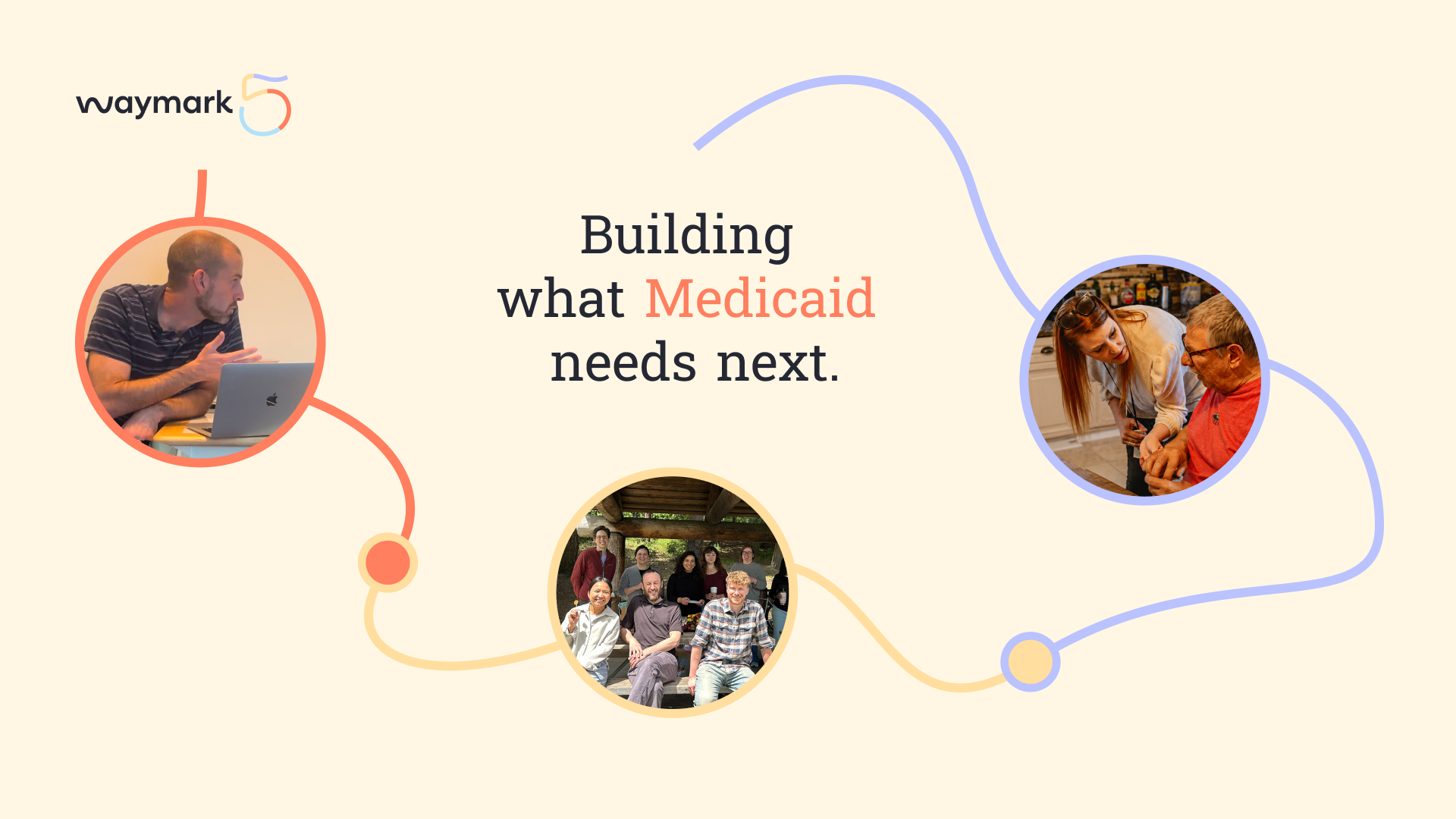
Waymark is five years old this month. We founded this company because, as physicians and health tech executives, we had watched the system fail the people who could least afford it: patients waiting months for an appointment, prescriptions lapsing with no one to catch them, care stalling because a piece of paper never made it from one office to another.
Those failures are avoidable. They are the reason we built the company, and they are still the reason we exist. From the start, we believed data science and technology could help deliver better care for people the system has traditionally overlooked. We are proud that some of these problems happen less often now, for fewer people, because of the work Waymark has done over the past five years.
Today, Waymark is an AI-first community clinic for Medicaid patients operating across four states and ready to scale nationally. We have built a proprietary, peer-reviewed AI platform that identifies rising risk patients before they reach crisis, provides clinical decision support to deliver the right intervention at the right time, and keeps patients connected to their care 24/7. Our care teams of community health workers, pharmacists, pharmacy technicians, behavioral health therapists, care coordinators and physicians find patients where they are in the community, and provide the clinical and social support they need to stay healthy.
This progress stems from four commitments we made at the start: build for Medicaid, with real technology, backed by peer-reviewed evidence, and alongside the communities we serve. We are proud of what these five years have produced, and clear-eyed that the work is far from finished.
Built for Medicaid
We started Waymark to serve people enrolled in Medicaid. Nearly 40% of hospital and ER visits in Medicaid are preventable, meaning they could be avoided through timely access to primary care and social support. We saw a better way to meet those needs where they actually arise: outside of traditional clinical settings and directly in the community.
In our first year of service, our model produced measurable results. A peer-reviewed study published in NEJM Catalyst demonstrated that Waymark's model reduced avoidable hospitalizations by 48% and avoidable emergency department visits by 20%, saving $2,347 per patient per year relative to a matched control group. Just as importantly, our community-based teams helped patients complete 63% of their self-identified goals. Behind each of those numbers is a person who received the care they needed, before it turned into a crisis.
The next five years are about scaling our model of AI-first, community care nationally, and supporting more patients who are disconnected from the traditional healthcare system.
Built with technology
AI and ML have been core to our approach since our founding, and for a specific reason: traditional care management programs only identify patients after they’re already high cost. Proactive identification and intervention required building novel machine learning models designed specifically for the Medicaid population. That is the basis of Waymark Signal™: a suite of predictive models trained on national Medicaid data spanning over 30 million people, and designed to predict rising risk and likelihood to benefit from intervention, and provide actionable intervention guidance before it becomes a crisis. Importantly, Signal neutralized the bias found in previous models.
Over five years, our technology evolved from identifying patients to guiding their care. We have built reinforcement learning models that recommend the next best action for care teams; in a peer-reviewed study, Waymark's AI-guided care recommendations drove a 20.7% relative reduction in acute care events compared to community-based teams following standard protocols. With Waymark Compass, patients have 24/7 access to a physician-supervised AI assistant who schedules appointments, arranges transportation, and connects patients to their care team in over 25 languages.
As AI takes on more of the work of care, the bar for safety has to rise with it. This is why we built ANCHOR, a deterministic verification layer that checks every AI recommendation against thousands of established clinical guidelines before it reaches a clinician or patient. Medicaid patients have the least room for error, so our focus is on developing safer clinical AI that improves access and outcomes for historically underserved communities.
Built with community
From the beginning, we hired our care teams from the communities we serve, because the person most likely to reach a patient the system has failed is someone who shares their neighborhood, their language, and often their experience.
Five years in, that conviction has shaped how we deliver care. Our teams meet patients where they are — at home, by phone, over text — and address what actually drives avoidable hospital and ER visits: missed medications, untreated behavioral health needs, no ride to an appointment, no food in the house, and more. The technology points the way, but it's a CHW who rebuilds the relationship between a patient and their care.
The next five years are about extending that care to more people — deepening our roots in the communities we already serve, reaching the ones we haven't, and using virtual models of care to bring community-based support to more patients than physical presence alone could reach. As our footprint expands, our care will remain centered on the communities we serve.
Built on evidence
Healthcare is full of companies that claim results; very few submit them for review. We decided early on that Waymark wouldn't ask our partners or our patients to take our word for it. If our model worked, we would prove it the way medicine proves things: in peer-reviewed journals, with our methods and our data open to scrutiny. That was an unusual commitment for a startup, and a risky one.
Five years later, that discipline has become our foundation. Waymark's research has been published in more than 35 peer-reviewed studies, in journals including NEJM Catalyst, JAMA, and npj Digital Medicine — spanning the accuracy of our predictive models, the outcomes of our care model, and the safety of our AI. And because we publish, the field learns alongside us.
The next five years hold us to the same commitment. As our AI takes on more of the work of care — predicting risk, guiding decisions, engaging patients directly — the burden of proof rises with it. Every new capability we build will go through the same peer-reviewed scrutiny, because the patients we serve deserve evidence over assurances.
Built for this moment
We mark five years at a moment when Medicaid’s foundations are being tested. The program is facing significant financial, regulatory, and political pressures that are impacting access to care and sustainability. At the same time, AI is flooding into healthcare faster than anyone can verify its claims, and the gap between what's promised and what's proven has never been wider. Waymark was built to help our partners and patients navigate both of these realities.
The model we are scaling over the next five years and beyond is the one the past five years produced: an AI-first community clinic for Medicaid that will improve access, quality of care, and outcomes for historically underserved communities nationwide. We will continue improving our predictive technologies and developing safer clinical AI for patients. We will rely on care teams rooted in the communities they serve, and we will keep publishing what we learn, so the standard for what works in Medicaid keeps rising.
